
Searching for Porcelain & Pottery (138)
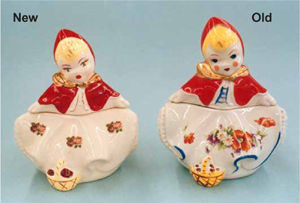
Reproductions of Little Red Riding Hood (LRRH) pottery have been filtering into the market for at least two to three years.

Throughout the 1970s and 1980s, a great number of new game plates and portrait pieces were imported into the United States by reproduction wholesalers and giftware distributors. Many of these new pieces had marks which were then, and now, easily confused with marks on old game and portrait plates. This article will review some of the most common decorations and marks used on these confusing pieces.

A major wave of new Staffordshire figures made in China is now flowing through the U.S. as well as international markets. Unlike many previous reproductions which were only slip cast, the new Chinese products are true pottery and are hand made in a similar style as old.

The original Hillbilly Frog cookie jar was made by Brush Pottery Company in 1969. It is believed less than 100 were made which have once been valued at around $4,000. The original mold was sold in 1992 to a potter who made 75-80 jars. These reissues are also highly sought after and once were valued at $650-$750. A third version is a low quality reproduction made since 1992 which sold for about $25.
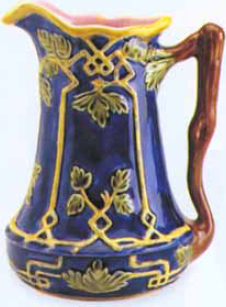
This new majolica pitcher is quite convincing at first glance. It has pink glazed interior and cobalt blue exterior. The ivy pattern is similar to authentic Victorian designs. It measures 5 high; no permanent mark; retail $18.
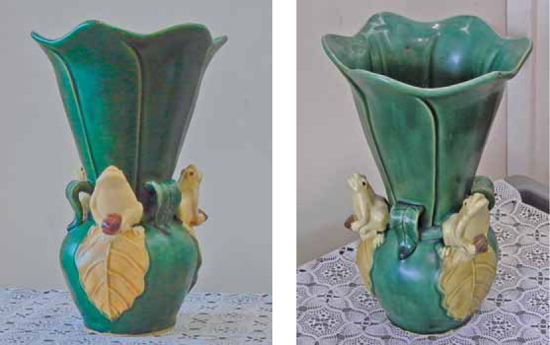
A new vase like the one shown below was recently offered as vintage Weller Pottery in an online auction.

Old Sleepy Eye collectibles are primarily premiums, advertising items and promotional pieces from the Sleepy Eye Milling Company of Sleepy Eye, Minnesota. The town's name and the company's distinctive trademark were taken from a Sioux Indian Chief, Old Sleepy Eye. Founded in 1883, the company continued in operation till 1921. One of their best known premiums is a series of blue and white pottery pitchers.
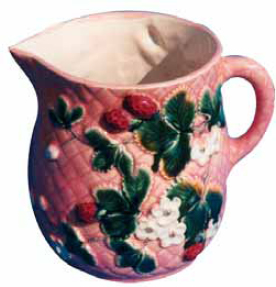
Reproduction majolica marked on the base with butterflies and flowers was sold in the mid 1990s. It was first reported in the New England states in 1994. Sam Pennington, who was at the time the publisher of Maine Antique Digest (MAD), obtained the sample (Fig. 1) after hearing complaints from dealers and collectors. Note the unusual impressed markings of butterflies and flowers (Fig. 2). These markings have no known old counterpart.

Flow Blue Waldorf and Iris patterns reproduced. Burslem, England, Royal Doulton, Arthur J. Wilkinson, W & E Corn, Mason's and Cauldon. Dunn Bennett. Stanley Pottery.
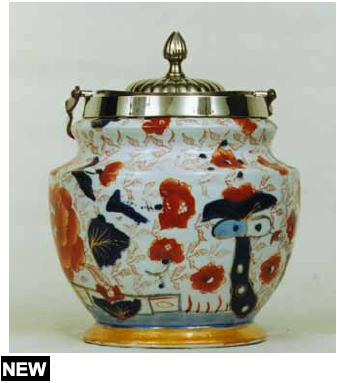
Two more confusing new marks have been found on reproductions of 19th century ceramics. The new marks are applied in dark blue transfer. ACRN found the crown mark on biscuit jars decorated in Masons Japan style decoration and the ribbon mark on a toast rack with chintz styled decoration. Like other confusing new marks, these two recent additions can be expected to show up on a wide variety of 19th century copies. These pieces with their facsimiles of old marks are being made in China for the antique reproduction wholesale trade.