
Searching for Collectibles (403)
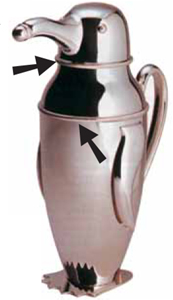
The list of reproductions of expensive Art Deco cocktail shakers continues to grow. Another figural penguin shaker needs to be added to the list. This version is a copy of a copy.
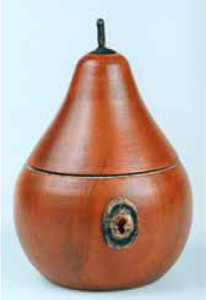
Copies of figural wooden tea caddies are now available. Three shapes are offered: a pear (shown here), a plum and a papaya. Original figural fruit tea caddies date to the 18th and early 19th centuries. Originals were mostly made of fruitwood and now sell for $1,500-$3,000 and up. The new pieces are fairly crude painted tropical wood made in Indonesia. The keyhole is purely decorative, there is no locking mechanism inside.
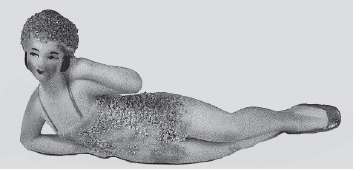
Their looks aren't in question but their age is. All of a sudden the same 3 figure (shown at right) is showing up in multiple Internet auctions. The straps and shoes are blue, no detail in fingers and hands, too much red in the cheeks.

Silversmith James Mackie has added items to his line of reproduction Victorian silver-plated figural napkin rings. Mackies products are the highest quality reproduction figural napkin rings in the market. The detail is very fine, wheels roll smoothly on the carts and the finish is true silver plate. All of the 20 different pieces made are recreations of specific originals. Although the new rings are sold as modern collectibles, many find their way into the antiques market by way of unethical or simply misinformed secondary sellers.
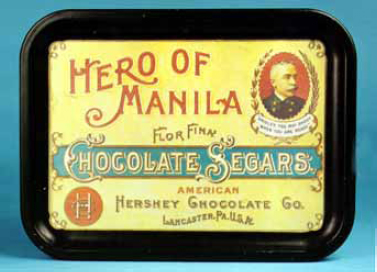
The year 1998 marks the centennial of the Spanish American War. Next to Teddy Roosevelt, the wars leading hero was Admiral George Dewey who commanded the United States Naval fleet. Under Dewey, the American fleet attacked and sunk the majority of the Spanish fleet at the Battle of Manila Bay in the Philippines on May 1, 1898. Dewey became an instant hero and his image appeared on everything from whiskey flasks to demitasse spoons and was used to advertise just about every type of product from phonographs to chocolate segars on the reproduction tray shown above.

Additional names continue to be found on new brass scientific instruments currently being imported from India. The example shown here is marked "G. Wright, Wm. Thomson (Baron Kelvin) Clark & Kelvin & J. White, London. Levels, compasses, sextants, and telescopes.
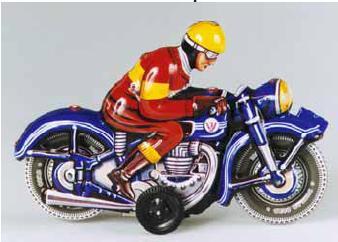
Original dies used to make a classic tin lithographed toy are back in production. The 6 motorcycle shown above was originally made Tipp Company Tippco of Nuremberg, Germany, ca. 195060s. All originals are marked with the company monogram of the letter T intertwined with C and O see Fig. 4 below.
A new technique is being used to apply fraudulent markings to clock faces. The forger is using black rubon lettering. Such lettering comes in sheets sold at art supply stores. Individual letters are transferred to an object off the carrier sheet by pressing or rubbing.
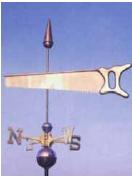
Original trade sign weather vanes advertised the work or occupation conducted in the building where they were mounted. Typical subjects were cigars for tobacco shops, an anvil for blacksmiths, a fish for seafood markets and so on. A hand saw vane is now being reproduced similar to an original made by 19th century factories like J.W. Fiske