
Searching for galle (15)
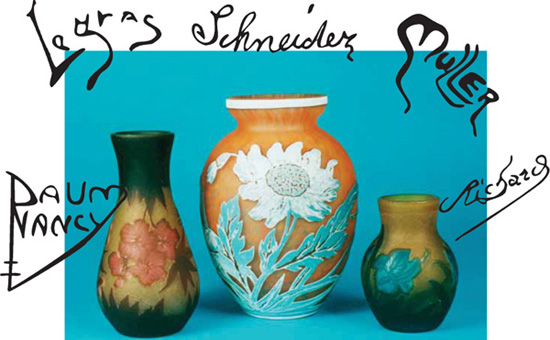
Reproduction cameo glass marked Galle has been in the market since at least 1993. Until recently, it was thought that Galle was the only significant mark appearing on cameo reproductions.
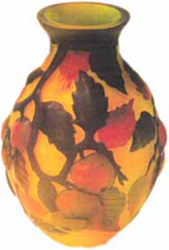
Reproduction cameo glass includes many new shapes as well as imitations of mold blown pieces (also called blow outs). Like much other new cameo introduced over the years past, these pieces also have a raised glass signature of ″Galle″. But these pieces are made in Romania and originally carry another raised signature of ″Tip″. Cameo reproductions from China and Taiwan.
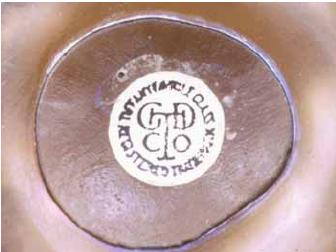
Several pieces of new iridescent glass recently showed up at an auction gallery with faked Tiffany paper labels see Figs. 12 above. The two pieces with the paper labels were among a group of four pieces all of which had faked and forged Tiffany marks. The group was attempting to be consigned by one person. All items were rejected by the auction gallery. How can you tell old from new Here are some hints and clues.
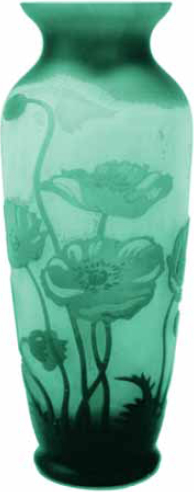
In the early 1990s, new cameo glass marked Galle began to be made in Taiwan. Some Galle signatures on the Taiwan reproductions are very similar to signatures found on vintage pieces; other new marks are fairly obviously fakes. Typical signatures found on the Taiwan cameo is shown on the next page
Dalian Mornlight Decorating Company of Dalian, China offered their multicolored cameo glass lamps and vases with custom order images or words for as little as $30.00 per piece. The custom work is in addition to a full line of stock cameo glass the firm made with facsimile signatures of original cameo makers such as Galle.
In an April 12, 1996 issue of Antiques and The Arts Weekly (The Bee), page 63, a report appeared about an auction held in Montreal, Canada on March 19, 1996 by Sylvain Collins. Among the items reported selling were an authorized reproduction Galle urn shape vase, signed Galle and Tip measuring 13 high, selling for $3,800 and an authorized reproduction Galle urn shaped vase, signed Galle and Tip, measuring 20 high went for $1,700 (italics added by ACRN).
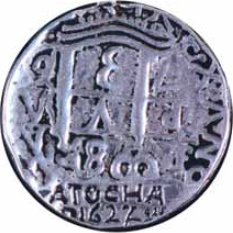
Florida authorities are investigating the age of gold coins claimed to have been salvaged from Spanish treasure ships. The coins in question have been offered with certificates of authenticity at a shop operated by famous treasure hunter Mel Fisher. Gold and silver coins, precious stones and other artifacts in the shop are priced up to $15,000 and more. Fishers shop was raided Wednesday, April 23, 1998 by the Monroe County State Attorneys Office and Florida Department of Law Enforcement.
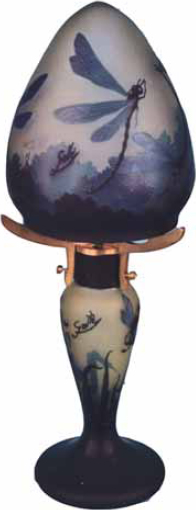
In February 1994, ACRN reported on a new series of lamps made of high quality cameo glass with Galle marks. The new lamps are made in Romania. In additional to the raised Galle mark, each piece carries a secondary mark, TIP which is the Romanian word for type.
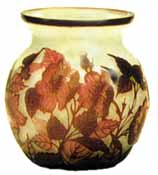
One of the more rare and expensive types of Galle cameo glass is the kind where the main pattern is mold blown also called blown out and sometimes called souffl in Europe. Although all production Gall was blown in molds to create the basic shape, the term moldblown means pieces whose raised designs were formed primarily in the mold. This is to separate them from those pieces whose designs were formed primarily by acid etching. Moldblown designs are much more highly raised and are more three dimensional than the designs created by acid etching. Since the raised designs of mold blown pieces are essentially hollow, they give the appearance as if filled with light and seem to have an internal glow.
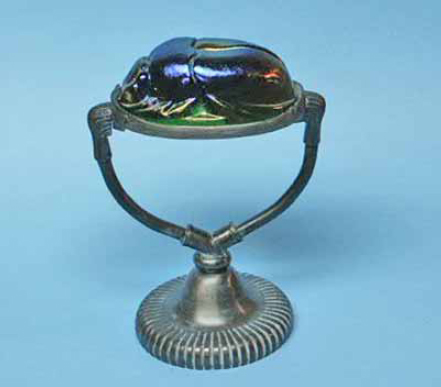
Scarab beetles have been a symbol of good fortune and long life since the time of ancient Egypt. The use of scarabs, dragonflies and other insects was revived during the Art Nouveau period which took its subjects and themes from nature. All the important designers of Art Nouveau glass--such as Emile Galle, Rene Lalique and Louis C. Tiffany - used insects in their work but Tiffany's three dimensional iridescent glass scarabs are probably the most well known. Look-alike Tiffany scarabs are now on the market.