Searching for Glass (303)
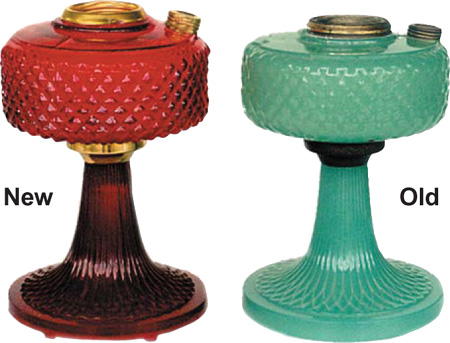
Reproduction Diamond Quilted lamp (left) compared with original Aladdin (Quilt) Style B-86 sold in 1937 (right). Aladdin did not sell this pattern style in red glass. Also there is difference in the original collar (plated and depressed groove) verses the new one (smooth plain). The reproduction is 10- inches tall with six well formed feet. The quilted pattern of the reproduction is sharper than the original.
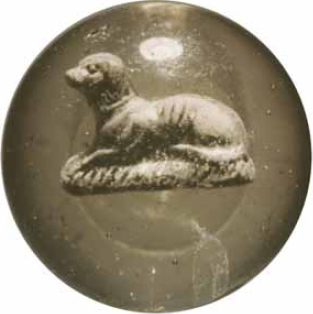
Glass marbles with sulphide figures never seen before began appearing between December 1993 and February 1994. Many of the marbles have two separate figures (Fig. 1-B) which collectors call "doubles." The problem is that before the new groups entered the market there were less than one dozen original doubles previously known. Are the recently offered doubles and singles genuine Victorian-era originals? This article will compare known old original sulphides with the unknown types that began appearing in late 1993.
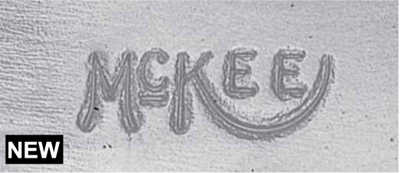
New milk glass with the molded McKee script mark first started appearing in 1998. At that time, the only documented script McKee-marked reproduction was the double-humped camel covered dish. Other new pieces were rumored to exist, but none were proven. Three more new pieces with the McKee script mark were found in 1999.
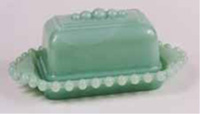
Original Candlewick was one of Imperial Glass Corporations most popular patterns. It was introduced in 1936 and made until Imperial closed in 1984. Many of the molds have survived and are frequently used for new products. The latest new products are two butter dishes made in opaque green glass, or Jadite. The two shapes in production are 400/161 with beaded top, shown here, and 400/276 with no beads on top, commonly called California. No original Candlewick was made in Jadite.
In April 2000, the Bob Goodman Auction Co. of Hot Springs, Arkansas auctioned the final remaining glass molds from the now out of business L. G. Wright Glass company. These were molds not offered at the May 1999 sale of the Wright factory contents in West Virginia.
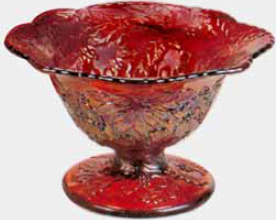
The Christmas pattern compote is among the most rare and expensive pieces of carnival glass. It was originally produced about 1909 in purple and marigold by the Dugan Glass Company. Collectors call it the Christmas compote because holly leaves are embossed over the entire surface. In recent years, pieces have sold in the $3,000- $4,000 range. Depression glass.

Two covered animal dishes marked Westmoreland have just been made available in vaseline glass through a Midwestern wholesaler. The two pieces, shown above, are a 5 lion on split rib base and a 5 chicken with split tail on a woven base. Both were made with uranium and do fluoresce under long wave black light. Red streaked milk glass, chicken, lion, Mosser, animal dish, uranium.
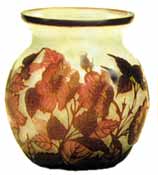
One of the more rare and expensive types of Galle cameo glass is the kind where the main pattern is mold blown also called blown out and sometimes called souffl in Europe. Although all production Gall was blown in molds to create the basic shape, the term moldblown means pieces whose raised designs were formed primarily in the mold. This is to separate them from those pieces whose designs were formed primarily by acid etching. Moldblown designs are much more highly raised and are more three dimensional than the designs created by acid etching. Since the raised designs of mold blown pieces are essentially hollow, they give the appearance as if filled with light and seem to have an internal glow.

Several Midwestern glass workers have been reworking antique and collectible marbles. The reworked pieces are suspected of having been created from original factory scraps and original damaged marbles. These bits and pieces are heated and joined in unusual styles and color combinations that would make them very desirable if old. According to Stanley Block of Blocks Box, a leading appraiser and auctioneer of antique and collectible marbles, there are several ways to detect reworked marbles.
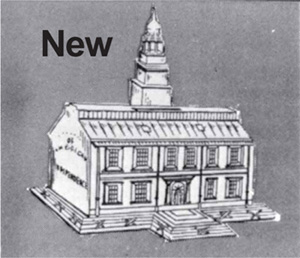
Many glass novelties were made for the United States Centennial Exposition of 1876 held in Philadelphia, Pennsylvania. One of the more sought after items is a figural bank candy container in the shape of Independence Hall. A confusing look-alike of this piece was reproduced in the 1970s and is often mistaken for the original. Genuine old pieces were made in both white milk glass and clear crystal. Old clear pieces were priced around $350 and up; milk glass, $400 and up. Gillinder Glass, B. Shackman.