
Searching for Glass (303)
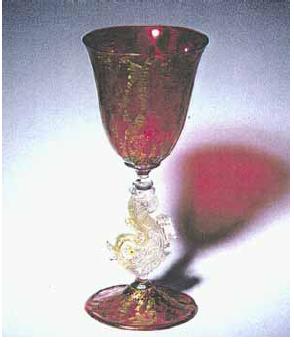
A New York design firm is currently offering a line of new Venetian glass virtually identical in design and construction to antique and collectible Venetian glass. The collection includes 11 wine glasses and 12 stirring rods, or swizzle sticks.
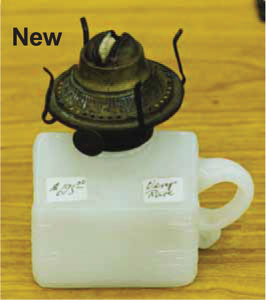
In August, 1997, ACRN reported on the appearance of new Log Cabin figural lamps. The new lamps were made in a number of colors, but only a clear glass example was available to photograph when the 1997 article went to press.

Be very careful if youre offered a Jadite ball-shaped pitcher. ACRN recently purchased a Jadite reproduction that is virtually an exact copy of Anchor Hockings vintage Pillar Optic pitcher (see Figs. 1 2) This pitcher was on several online auction sites the second week of June, 2001 and will probably be drifting into outdoor markets, malls and shows this summer.
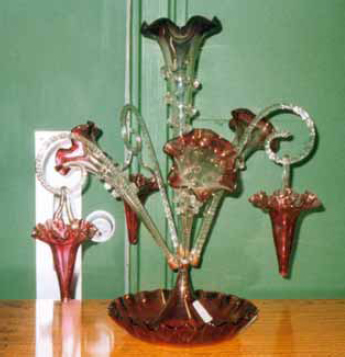
A subscriber found this epergne with baskets at an auction house in Charlotte, North Carolina. The piece aroused suspicion because the glass seemed too heavy and the red areas had too much purple. When an auction house employee was questioned about the piece, our subscriber was told it was a reproduction. This fact, however, was not mentioned when the epergne was offered for sale. It was bought back in at $400.
This figural egg cup with the face of a child is new in the market. It is being produced in an opaque green (Jadite), opaque blue (Delphite) and Ice, an iridized finish.
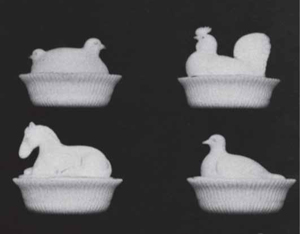
A reproduction of the classic McKee split rib base is now out in the market with the new script McKee mark. Thirty five new bases were offered through an Internet auction beginning April 22, 199 for a minimum bid of $50 each. The auction closed on April 23 with no bids received.

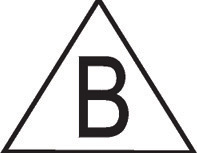
A subscriber recently wrote inquiring about a molded mark of a V in a circle on a piece of Greentown Holly pattern glass. The writer correctly identified the glass as new but mistook the mark for Viking.
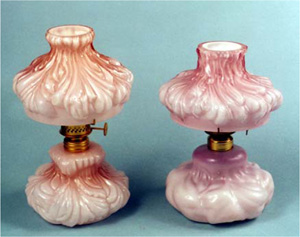
Miniature glass oil-burning lamps were popular from the last quarter of the 19th century through the first quarter of the 20th century, ca. 1875-1925. There is some debate over the exact use of miniature lamps. Collectors often use the names courting lamps, night lights, childrens lamps or toy lamps depending on what purpose they believe the originals lamps served.

Glass has been found with forged Durand marks acid stamped in block-style lettering (Fig. 2). Both pieces were new glass with blue iridescent finishes; one a blue fanshaped vase, the other a jack-in-pulpit style piece. Both pieces had rough pontils. Original Durand was never marked with acid stamps and has polished pontils. Most early pieces were marked with a paper label only. Later, Durand was engraved in script by itself or appeared over a large V.
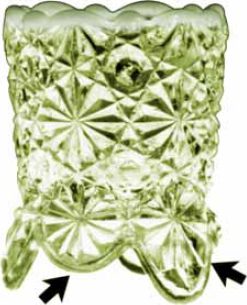
Daisy and Button (DB) is one of the most popular patterns in pressed glass ever made. The basic pattern is made up of eightsided buttons which surround geometrically stylized flowers. The pattern was so popular that some variation of DB was made by almost every major Victorian era glass company.