
Searching for Glass (303)
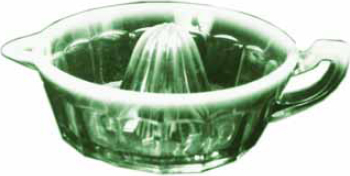
The reamer style in Fig. 1 is from an original Westmoreland Glass Company mold. This new piece is green with a white opalescent top rim. No old reamers of this style were ever made in green opalescent.
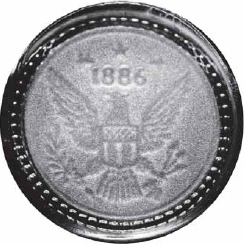
Fostoria Glass Company of Moundsville, West Virginia also made a line of glass decorated with coins. It was called simply "Coin Pattern" and was #1372 in Fostoria's catalog.
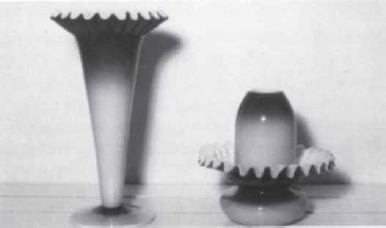
In 1886, a Chinese porcelain vase with "Peach Bloom" glaze sold at auction for $18,000. The tremendous price and the phrase Peach Bloom were widely publicized. Within months, American glass companies developed new formulas to capitalize on the Peach Bloom name. This glassware that is now collectively referred to as "Peachblow".
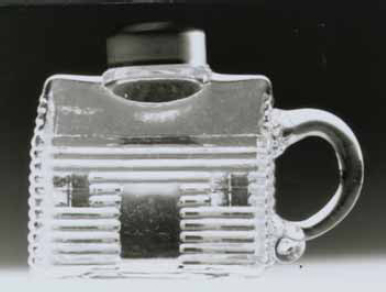
The log cabin theme was used by several glass companies around the time of the American Centennial celebration of 1876. Best known is probably the pressed glass tableware made by Central Glass Company of Wheeling, West Virginia issued during the mid-1870's. Less well known is a small figural log cabin lamp made about the same time by the Thomas Atterbury Glass and Lamp Company.
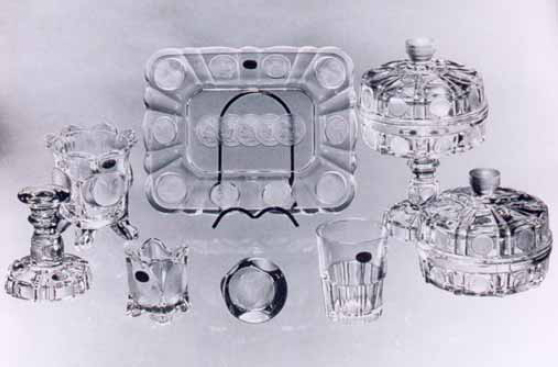
A joint article by Tim Timmerman, author U.S. Coin Glass: A Century of Mystery and ACRN
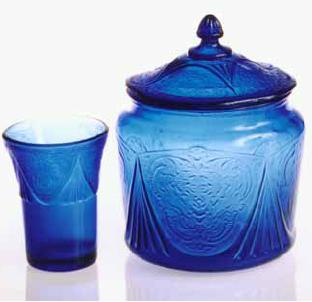
Original pieces in cobalt blue Royal Lace are among the most scarce and expensive pieces of American depression glass. In 1996, the Royal Lace 5 ounce juice glass was reproduced in cobalt. Now, in the summer of 1997, cobalt reproduction Royal Lace 9 ounce tumblers and cookie jars have appeared.
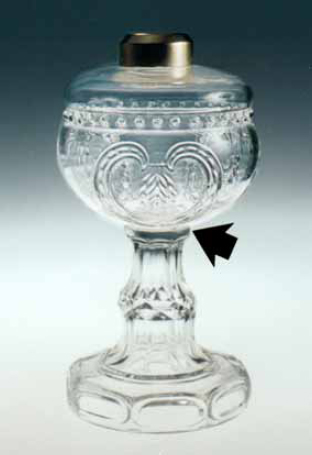
The original Wheat in Shield glass kerosene lamp was made by Central Glass Co. based on a pattern that was patented in 1871. It is believed to have been produced only in clear crystal. Original lamps were made in an 8 inch table model, and 3 1/4 and 5 inch models, nd some were made with handles. A new 8 inch Wheat in Shield lamp is now being produced in clear crystal (shown above), plus green, cobalt blue, white glass (milk glass) and pink.
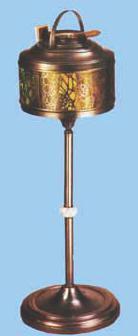
This new 33 smoke stand has a band of slag glass around the top. It is overlaid with a pierced metal design and illuminated from the inside. It is copied from original stained glass smoke stands popular ca. 1895-1920.
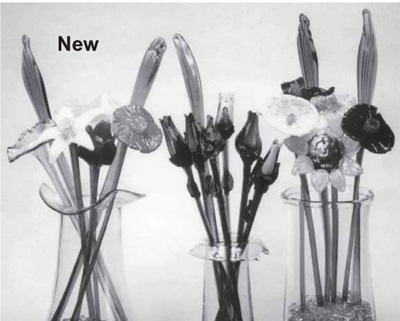
A wide variety of new glass fruits and flowers were once being exported to the United States from the Czech Republic (formerly Czechoslovakia). These three dimensional glass pieces closely resemble glass fruits and flowers made in Venice, Italy from ca. 1920s-ca. 1960s. Some Venetian flowers, fruits and plant-related items from the 1930s by famous designers such as Martinuzzi, have sold for as high as $30,000. Typical Venetian fruits from ca. 1950-1960s can sell for $50 to several hundred dollars. New Czech fruit retails from $10-$69 each; new Czech flowers from $28--$46 a stem.