
Searching for Glass (303)

New glass vases with lizards made in the Art Nouveau style are being found marked Galle and Daum Nancy. A single lizard figure is entwined as if climbing around the neck of the vase.
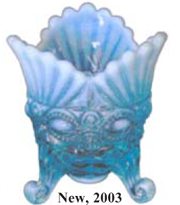
New pieces of Eyewinker pattern glass are now being sold in blue opalescent and green opalescent. Blue opalescent is available in the 6-inch three-footed shape shown here and a quart-size pitcher with tumblers. The green opalescent is also sold in the three-legged shape.
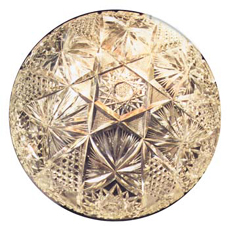
New cut glass made with stone wheels is very similar to vintage American Brilliant Period cut glass made from around 1880 to about WW I.

This new 6-inch opaque green glass, or Jadite, canister was found in a Midwest antique mall. The cylindrical shaped bodies are covered with a dome-shaped lid. TEA in raised molded letters is on the front. A second matching canister was marked COFFEE.

Inexpensive 8-inch vases imitating mid-20th century styles from Murano, Italy are being exported in large quantities from China.
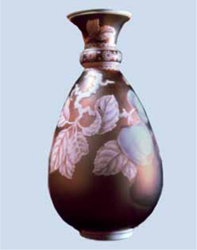
The name Webb has been associated with English glass since the 18th century. Its probably as well known among Americans as with English collectors.
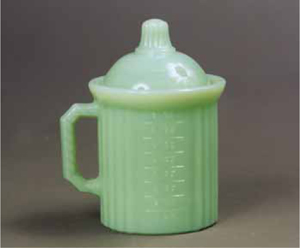
A line of new kitchen glassware has just appeared in the market. Most pieces are in opaque green glass commonly called Jadite but some are also available in vaseline and cobalt blue.
Vaseline is the latest color to be made into new bottoms up tumblers. Original bottoms up tumblers were by McKee Glass Co. Authentic pieces have Pat 77725 in raised lettering between the nudes feet and the tumbler rim. New tumblers do not have the patent number. The new tumblers fluoresce under long wave black light indicating their formula includes uranium. McKee never made any original tumblers in vaseline glass.
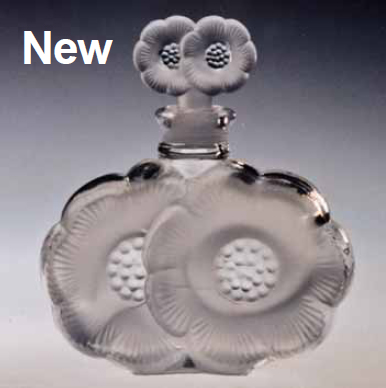
Rene Lalique (1860-1945) was one of the most successful artist/designers of all time. He was successful designing jewelry, wallpaper, textiles, and commercial packaging but it is his glass wares that brought him the most fame. Lalique began commercial production of his own glass around 1905 and carried on his work until his death in 1945. The glass business was carried on by his son Marc(d. 1977), then his granddaughter, Marie-Claude Lalique, and is still operating today as Cristal Lalique. This article will compare authentic Lalique glass and its marks to present day and earlier imitations, fakes and copies and reproductions. This will include an explanation of original and forged marks, typical design features, production details and ingredients in the glass,
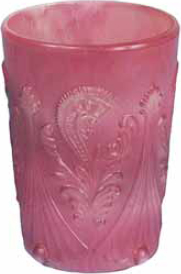
Original pink slag appears as a swirl of pink and white glass. The reproduction tumbler below is actually a custard colored base glass with a flashed on swirl of pink paint.