
Searching for Collectibles (403)
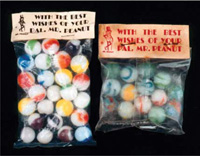
The hobby of collecting antique marbles is already several decades old. However, in the past ten years or so marbles have become one of the most popular types of collectible toys. It is only in this recent period that collectors have turned their attention from handmade German marbles of the latter half of the nineteenth century and very early twentieth century to include the machine made marbles that eventually supplanted the former around the time of the First World War. And as with any type of collectible, such marbles in their original packaging are much more desirable than those that are not.
Nothing brings out counterfeits like fads and crazes. Adults have always been tempted by fake Picassos and Gucci handbags. Now kids have to beware cheap copies of wildly popular Pokémon cards.
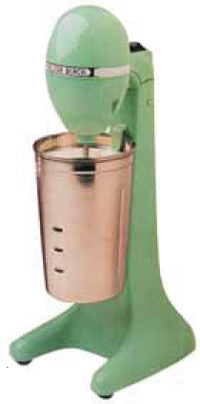
Introduced in 1934, the Hamilton Beach Drinkmaster mixer has been a standard for Art Deco collectors as well as persons recreating the 1950s look in family rooms. The design is so popular its back in production.
A new generation of faked ambrotypes are being seen in the market. Photographic image specialist Wesley Cowan of Historical Americana Auction told ACRN of recently examining a faked ambrotype of George A. Custer.
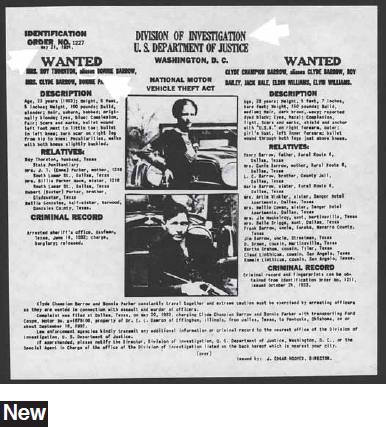
The fake Bonnie and Clyde poster below (Fig. 1) was recently sold for over $300 through a phone/mail auction. It was described as original and came with a letter of authenticity. The auctioneer personally told the buyer it was absolutely authentic. When the poster was delivered to the buyer, a retired FBI agent, he had the advantage of comparing it to genuinely old posters he already owned and found major problems. Federal Bureau of Investigation - John Dillinger, Machine Gun Kelly
Two of the best indicators of age and authenticity of marble used in Victorian furniture, 18401885, is color and thickness. Virtually all original 19th century marble measures a full 1516th of an inch. Modern marble replacements by contrast measure only 34. Although not easily seen by the eye, this is easily measured with any inexpensive set of calipers or ruler.
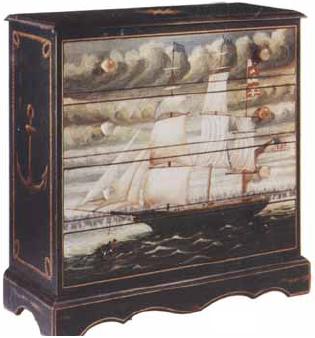
For years, the majority of reproduction American antique furniture was made of traditional stained hardwoods. Recent trends, however, have been towards ever increasing amounts of reproduction painted furniture decorated in country and folk art styles. Most of these painted reproductions are imported from India, Indonesia and Mexico. The low wages paid in those countries allow manufacturers to apply extensive hand painting that can be confused with hand work found on antique painted furniture. In this article well look at how to separate the new from old painted furniture based on paint, construction details and determining if wear is natural or artificial. This article will focus on the country and folk style painted furniture originally made at home or in very small rural furniture shops up till the last quarter of the 19th century. The formally painted furniture from master cabinet makers in large cities is not included.
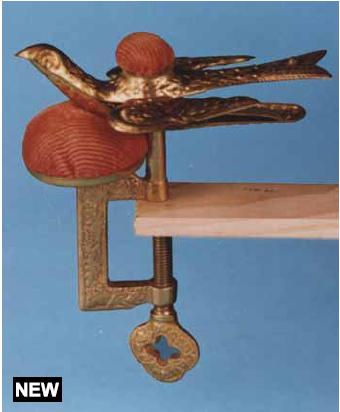
A sewing bird is a type of figural sewing clamp developed in America in the early 1850s. Original clamps helped hold large folds or lengths of fabric during hemming. A modern reproduction sewing bird was reproduced in the 1950s and was made again in the late 1980s.

Marks 1 & 2 below should not be confused with the Tiffany marks they resemble. They are used by Paul Sahlin's Tiffany's Inc., a current manufacturer and importer of leaded, bent panel and other period lighting reproductions.
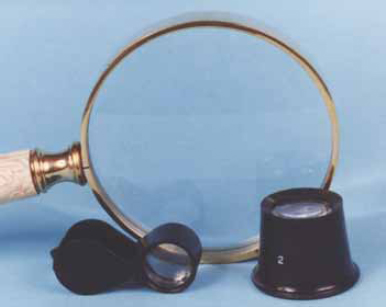
Perhaps no other piece of equipment can do collectors and dealers so much good for so little cost as pocketsized magnifying lenses. Surface textures that might indicate a repair may go undetected by the unaided eye but will show up clearly when enlarged. Decals can be distinguished from hand painted brush strokes, flaws in gemstones can be spotted and marks and signatures can be examined for authenticity.