
The Aging of DrawersBy JJ "Jake" DuPre
The Aging of Drawers
Every time I see some new piece of furniture sold for old, I'm reminded of a Lincoln story. Lincoln was summing up a case in which he thought a witness was less than truthful. To recall this to the jury, he asked a riddle. "If you call a cow's tail a leg", Lincoln began, "how many legs would a cow have?" He paused, then answered, "Just four – because calling a tail a leg don't make it so."
Just like calling a piece of furniture old, don't make it so. One of the ways to make sure a piece of furniture is actually old, and not over restored, reproduced or new, is to look for genuine signs of normal wear and aging. In this article, we will be discussing the aging and wear patterns on American bottom gliding drawers (Fig. 1).
Begin a drawer examination by pulling out and turning over the lowest or bottom drawer first. Look at the underside. Now pull out the highest or top drawer and look at the underneath side of it. The underneath side of the lowest drawer should be darker than the underneath side of the top drawer. Over many years the dirt, dust, grease and smoke circulating in room air is absorbed by the exposed bottom of the lowest drawer (Fig. 1). Less air reaches upper drawers because they are protected by the drawer(s) below. Less air means less exposure to smoke and grease. That's why the underneaths of genuinely old upper drawers are lighter in color than genuinely old lower drawers (Fig. 3).
This is generally true for all pieces of furniture regardless of the number of drawers (Fig. 2). Even if there are only two drawers, the underneath of the top-most drawer should be lighter than the underneath of the bottom-most drawer.
If you decide the bottoms of the drawers are correct and want to continue your examination, don't put the drawers back just yet. While you have them out, you should now check for several other small but important details that can tell you about age, repairs, extent of restoration and whether the finish is original.
Old furniture, like new furniture you buy today, is seldom finished the same way in areas that are visible and areas that are hidden. For example, the antique drawer in Fig. 5 shows a typical old original finish. The front of the drawer which is exposed to view has been stained and varnished. The sides of the drawer which are hidden from view, are not stained. In this particular example you can even tell the finish was applied to the front before the dovetails were cut because the tails of the front piece appear dark against the tails of the side. If a drawer is finished the same inside and out, on the sides, front and back, the drawer may be old but the finish is not.
There is no logical reason to have the same finish on the highly visible surfaces as on hidden surfaces. If you were a 18th or 19th century cabinet maker or factory owner, you were concerned with profit and speed of production. If you were making lots and lots of drawers, an ounce of stain saved on every drawer could mean considerable extra profits. So why waste time and money finishing areas that were never seen? Such waste isn't logical if you are making furniture. But an over zealous repair shop or someone imitating an old style, isn't concerned with such details because they are not making a piece of furniture. They are making an antique or piece of furniture meant to look antique.
In other words, when you examine a piece try to think like a cabinet maker earning a living. Be suspicious of finished surfaces in unseen areas and illogical use of (costly) raw materials.
Use this approach when you look at the types of wood(s) used in the drawers. Old original drawers were normally built with a minimum of two woods and can be found with as many as three to four. That's because different woods were used for different purposes. The main wood or primary wood was used for the most important exposed surfaces. Woods which were exposed but in less noticeable areas are called secondary woods. Then there is the wood used for glue blocks, hidden structural supports and, in general, where ever a cheap wood can take the place of more expensive wood.
If you were a cabinet maker trying to squeeze more profit from every piece you build, you're going to use expensive primary wood only where absolutely necessary–– in places where it will be seen. In hidden away places, you would use cheaper woods.
A rear view of a typical antique drawer is shown in Fig. 6. This particular drawer uses a total of three different woods. The front and two sides are oak, the bottom is basswood and the back is maple. There is no relationship between the number of woods and the date of production. This particular drawer was made in a factory around 1880-1900; earlier pieces could have less or more. The important thing is to suspect a drawer made entirely of one species of wood. Using, say, all mahogany for sides, front, bottom and back would never have made economic sense if a period cabinet maker was making a piece of furniture. Why use expensive woods in places where they wouldn't be seen?
Continue to use this same logic to examine the surface. Surfaces in old drawers generally show different degrees of finishing logically based on the purpose and visibility of the surface. For example the back of the drawer in Fig. 6 shows deep vertical saw marks. Why? Because it didn't make any economic sense to smooth a surface nobody would ever see. The side that faces the inside of the drawer– which would be touched, etc.– is smooth but not the outside. Glue blocks, for example, and back sides of boards and other hidden surfaces were generally not smoothed as much as the surfaces which would be painted, stained or varnished.
Other details worth considering are glue spills and runs. In Fig. 7, spot A is an original glue run on a drawer bottom. You can tell it was applied when the furniture was made because the wood under the glue is lighter in color than the surrounding wood. The glue protected the wood it covered from the years of dirt and grease which darkened the exposed wood surrounding the glue. If the glue had been recently applied, the wood under the glue would be the same color as the surrounding wood.
As a final check, look for the proper signs of wear to the wood itself. Opening a bottom glide drawer wears the drawer along two main surfaces. As the drawer is pulled out, it wears along the entire length of the runner shown as Fig. 8-A. As the drawer is pulled out further, the front drops causing wear along the back edge as in Fig. 8-B. This produces the characteristic wear pattern (shown exaggerated) in Fig. 8-C.
There could be several reasons why the drawers you look at don't follow the general guidelines above. The drawers may have been dipped in stripper or refinished, various pieces could have been replaced or repaired, the drawer can be original to the piece but put back in the wrong order, the entire drawer might have been replaced or the entire piece might be new.
In some cases, original construction, finish and condition may not be all that important. But if you are being asked to believe a piece is indeed "original" and you are asked to pay more for "original" condition, use the guidelines above to make sure you get what you pay for.
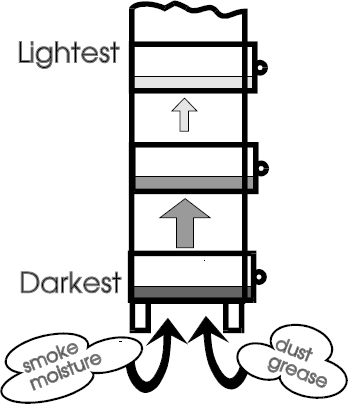
Fig.1 The underneath side of the lowest drawer on most antique furniture is open and exposed to the air. Over the years smoke, grease, dirt and moisture circulating with the room air cause this exposed side to darken. Upper drawers which were protected by the bottom drawer(s), were exposed to less air and therefore less smoke, grease, etc,. In old furniture with drawers, the underneath side of the lowest drawer should be darker than the underneath side of the highest drawer
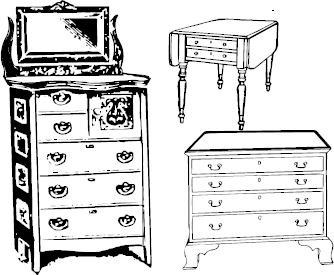
Fig. 2 The information in this article can be used with any piece of furniture with drawers.
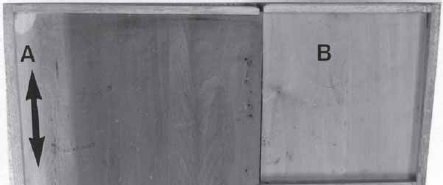
Fig. 3
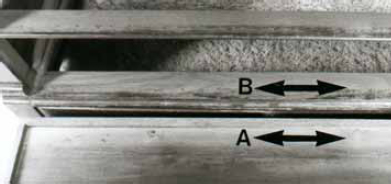
Fig. 4
Figs. 3-4 Drawer A in Fig. 3 is the lowest drawer in a ca. 1880 chest. Exposure to the air has made it darker than drawer (B) the top draw from the same chest. The light colored band along the double arrow of (A) in Fig. 3 is also shown as (A) in Fig. 4. The light band exactly matches the dresser frame (B) in Fig. 4. The area protected by the frame has remained light.
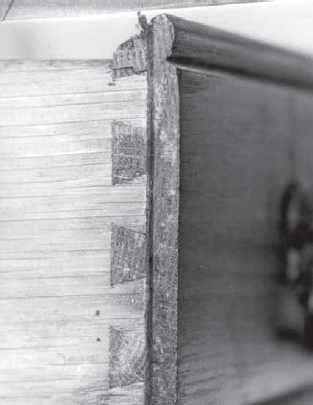
Fig. 5 Usually, original stains and finishes on genuine antique drawers do not cover areas normally hidden from view. The original finish on the antique drawer in Fig. 5 for example, stops at the dovetail joint . The front of the drawer, which is exposed to view, is finished; the side of the drawer, which is usually hidden, is unfinished.
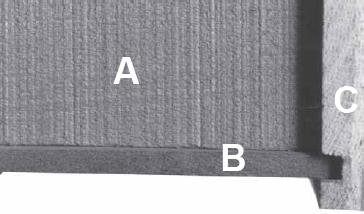
Fig. 6 This rear view of the outside back of an old drawer shows different woods used in the side (A), bottom (B) and back (C). Also note that the surface of each piece is finished differently. The back piece has vertical saw marks, the bottom has circular saw marks and the side has been planed smooth.
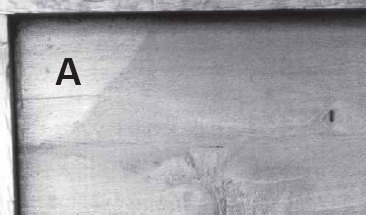
Fig. 7 Glue applied during the making of this old drawer has protected the wood underneath which is lighter (A) than the unprotected wood surrounding it which has been darkened by age.
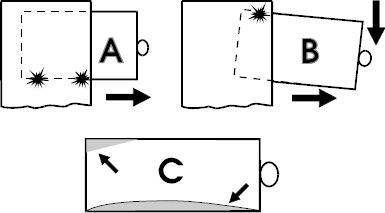
Fig. 8 As a bottom glide drawer is pulled out, it moves in two directions–horizontally and vertically. This two way movement produces wear along the bottom edges (A) and the rear top corners (B). This wear pattern is shown exaggerated in (C). Note that the bottom wears in a curve; the rear corners wear in sloping line.
 — the award-winning marketplace trusted by collectors worldwide.
Now that you know what to avoid...
♥️ Find the Real Deal on Ruby Lane
Shop with confidence from our vetted dealers who specialize in authentic vintage and antique treasures.


