
New brass match safesBy Mark Chervenka
New brass match safes
Copied from figural and advertising originals
Reproduction match safes include fraternal, figural and advertising pieces. Most are direct copies of well known originals. All of the match safes shown in Fig. 1 are new brass reproductions. Average price was under $30 each.
Until late 2003, the great majority of reproduction match safes were made of silver. But another wave of new safes was made of brass. This brass group includes some items never before reproduced including figural, fraternal and advertising pieces.
Most of the new safes shown in this article seem to originate with English dealers. Whether they are made in England or made in other countries for English wholesalers is unclear. The majority of the new pieces in this article are priced between $20 and $30 dollars. All have been seen bringing substantially more from buyers who are not aware of their recent origins.
This article shows some of the best tests for catching pieces from this group. Old originals are shown side by side with the reproductions to illustrate the differences.
Common problems with many new safes
Obvious seams
Many reproduction match safes have crude and obvious seams in the body. Bodies of vintage match safes–in silver or brass–rarely show obvious seams. Generally, you should consider prominent seams a warning sign of a reproduction. The photos of new and old seams below are typical examples.
Poorly formed tension bars
The tension bar is the piece or mechanism that keeps the match safe lid closed. Functional vintage match safes, made to protect and keep matches dry, had tight fitting lids. Tension bars in vintage safes range from simple bars to fairly complex patented systems. But all were capable of keeping the lid closed.
Many new safes, made as "collectibles" which don't have to keep matches dry, have weak or poorly formed tension bars resulting in loose, ill-fitting lids. Check the alignment of tension bar pieces and mechanisms. All parts should make contact at logical points (see Fig. 4). Many reproduction manufacturers use the same tension bar in all their safes regardless of style or model. If the same tension bar appears in all or most of one seller's safes regardless of the size or styles of the safes, it might be a sign the safes are new.

Fig. 1

Fig. 2 Back of new brass devil head, left, and original silver devil head, right. Note the obvious seam in the new safe (arrow). Vintage safes, brass or silver, rarely have such prominent seams. Obvious seams are generally a sign of a reproduction.

Fig. 3-A Side view of typical new and old safes. The new brass safe, left, has an obvious seam.

Fig. 3-B Side view of new and old safes. The old safe has a smooth body. An obvious seam in the reproduction, left.

Fig. 4 Typical misaligned tension bar mechanism common in reproduction match safes.

Fig. 5 Many reproduction safes use stock pieces of metal in the tension mechanism. This unusually thick new tension bar (arrow) has simply been chopped off from a longer rod and soldered in the new safe.

Fig. 6

Fig. 7
Figs. 6-7 Two typical examples of patented tension bar mechanisms. Crimping, rivets and multiple-piece construction are all signs of vintage construction. Of course some vintage tension bars may be fairly simple. Just don't overlook the tension bar when you examine a match safe.
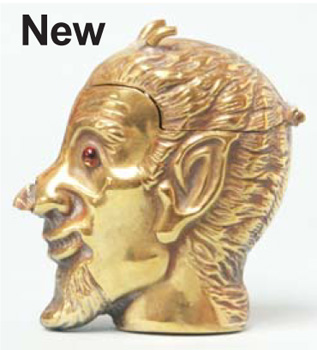
Fig. 8 New brass devil, red glass eyes, brass horns. All brass devil head safes are new. Hinge stands out away from back of head.
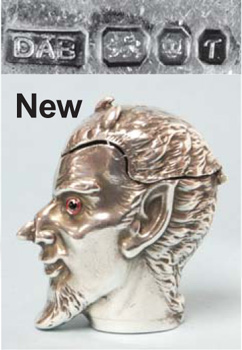
Fig. 9 New sterling silver devil, red glass eyes with black pupil; silver horns. Made since the 1970s, touch mark DAB. DAB silver dates only from 1970s at the earliest.

Fig. 10 Original sterling silver devil has ivory or bone horns, red glass eyes. All the devil head safes shown are slightly under two inches tall.

Fig. 11 New brass safe in Japanese style. Fairly well made and easily confused with the original shown in Fig. 13. The new safe can be identified by the large protruding hinge on the side (arrow). The seams along the side, shown in Fig. 3, are also very obvious. The new and old safe also differ in the striker shown in Fig. 12.

Fig. 12 The striker on the bottom of the new safe shown in Fig. 11 above. The new striker is molded within in the body of the safe. Compare this to the original striker in Fig. 14.
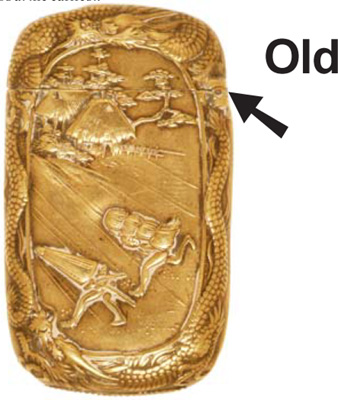
Fig. 13 Original brass safe from which the reproduction in Fig. 10 was copied. Note that the original hinge is incorporated into the overall design and blends into the body of the safe. The side seams, shown in Fig. 3, are virtually invisible. The striker on the original, Fig. 14 is also different from the reproduction.
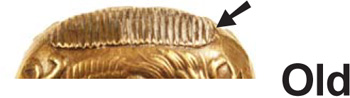
Fig. 14 The striker on the bottom of the original safe shown in Fig. 13. The original striker is made from a separate piece which is then applied to the bottom of the safe.
Panel-insert match safes new and old
Many original match safes with custom advertising, commemorative or fraternal messages and emblems are a type commonly called insert or panel. One of the most common forms is the one shown here patented in 1904. Custom panels or inserts fasten are attached to a mass produced body with clips and crimps. These old safes are made from multiple parts including top cap (with lid); bottom cap (with striker); body; custom insert and edge clips. Panel-insert safes are now being made as one-piece brass reproductions.

Fig. 15 Illustration of panel-insert style vintage match safe formed of multiple separate parts. Custom panels, on one or both sides, were clipped to the body. These safes are held together with clips, crimps and rivets, not solder.

Fig. 16 Assembled match safe. Custom panels were embossed metal, printed paper or celluloid. Stock images were also available for one or both sides. Lid and bottom cap were nickel plated brass; the body and side clips are silver-colored steel (magnetic).

Figs. 17-18 A reproduction brass panel-insert style match safe. The woman figure is a stock insert. The reverse of the new safe has an advertising message. The body of this new safe is one single piece, not made from multiple pieces as the original.

Fig. 19 Original panel-insert safe. This original is made from multiple pieces as shown in Figs. 15-16.

Fig. 20 Hinges on the new panel-insert safes extend out away from the body (arrow).

Fig. 21 Hinges on original panel-insert safes are flush with the body (arrow).
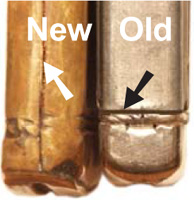
Fig. 22 The original multi-piece panel-insert body has many joints and seams. In this side view, there is an obvious seam between the body and the bottom cap (black arrow) of the old safe. However, there is no seam in the old side clip but an obvious seam on the side of the new body (white arrow).

Fig. 23 New brass panel-insert style match safe. Embossed with symbols and name of fraternal organization Independent Order of Foresters. The hinge on the new safe stands out away from the body. There are obvious seams in the sides. The custom insert is made in one piece with the entire body of the safe, it is not a separate piece attached to the body.

Fig. 24 New panel-insert safes generally lack the detail found on the originals. For example, look at this close up view of the new Forester safe shown in Fig. 21. Note the missing letters "OR" from ORDER and "S" from FORESTERS (white arrows).

Fig. 25 Original panel-insert style Independent Order of Foresters match safe. The hinge blends into the body, no seams in the sides, made from multiple separate body parts clipped, crimped and riveted together, not soldered. The custom insert is a separate piece attached to the body with clips.

Fig. 26 Authentic panel-insert safes generally have better detail than the reproductions. Compare the original symbolic eye (arrow) and moose head on this original to the reproduction.

Fig. 27 New brass horse and rider match safe. The hinge on the new safe extends out away from the body (arrow). There is an obvious soldered seam around the sides of the new safe. Poorly designed with little detail in the horse's mane or the rider.

Fig. 28 Original horse and rider match safe is nickel plated brass. The hinge is tucked into the body. A raised crimped seam, not a soldered seam, runs around the edges.

Fig. 29 New pins and balls brass match safe. Obvious seams, raised hinge.

Fig. 30 New golf theme brass match safe. There is a companion reproduction in silver marked 925.
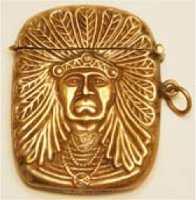
Fig. 31 New brass Indian chief. Also made in silver marked 925. This is an imitation of an original made by Unger Bros. The new safes have the same image on front and back. The original Unger Bros. has a plain back for engraving. Most, but not all, Unger originals will also be marked Unger. Webster Silver also made a vintage Chief, but those are more rectangular.
New and old match safes courtesy George Sparacio
 — the award-winning marketplace trusted by collectors worldwide.
Now that you know what to avoid...
♥️ Find the Real Deal on Ruby Lane
Shop with confidence from our vetted dealers who specialize in authentic vintage and antique treasures.


