
New Dazey 4-quart Glass BasesBy Mark Chervenka
New Dazey 4-quart Glass Bases
New glass four-quart Dazey Churns have been reproduced in India. There are several original styles of Dazey Churns. The style being shown here is the one Dazey Churn collectors refer to as the Patent Date or Sloped Shoulder.
Original four-quart Dazey Churns of this style in very good condition are worth $165-$195 with the beater mechanism. The glass base is the most valuable part of the churn, worth about 80% of the total value of a complete unit. An original base of this model is worth $125-$150 for the glass base only. The reproduction glass base, sold with a flat metal cap only without a beater mechanism, wholesaled for $15.75 each. In the wholesale catalog that offered the new glass body, the copy clearly states the new body "...can be used as a replacement if you have broken your old jar."
Many more original metal beater mechanisms have survived than the comparatively fragile glass bases. The new glass bases have already been widely offered with old mechanisms in on-line auctions, malls and outdoor markets. Just remember that original jars and lids required a watertight fit to contain the milk during churning. A loose fitting lid is a problem.
Probably the easiest way to separate new from old glass bases is to examine two specific molded details. One of these details is in the mark on the side, the other on the outside bottom of the base.
If you look at the molded lettering on the side of the old base, you'll see the last horizontal line of lettering is "Made in USA" (Fig. 7). New bases made in India, do not include "Made in USA" (Fig. 6). All other markings–such as the name, patent date, city and state are identical (the abbreviated patent date is Feb. 14th, 1922).
Now look at the bottom of the base. Old bases have a circular mark molded into the outside bottom (Fig. 9). The outside bottoms of new bases from India do not have the circular mark (Fig. 8).
The top rims of the new jars may be a particular problem for collectors. Those who specialize in Dazey Churns know the earliest original Dazey glass bases made ca. 1906-1920 have ground tops. Rims in originals made after the 1920s are molded smooth; not ground. However, the rim in the reproduction glass base is also ground. This could mislead buyers into thinking they are looking at an early Dazey, not a reproduction.
Another rim-related feature of the new glass bases is a peculiar up-down waviness along the circumference of the top rim. In other words, if you turn the body upside down on a perfectly flat surface, say a table, not all of the top rim will be in contact with the table (see Figs. 4, 4-A, 4-B). Original rims, which had to maintain a watertight seal to function as a churn, are very nearly perfectly flat along the circumference.
The original four-quart Patent Date model Dazey Churn was made between 1922 and the late 1930s.
Special thanks to Wendell Stream for providing background information on Dazey Churns for this article. Wendell is one of the nation's leading experts and dealers in glass churns.
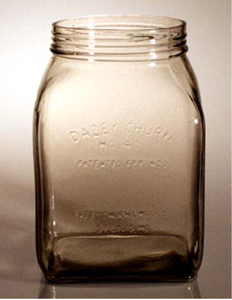
Fig. 1
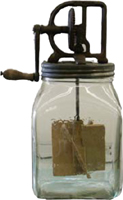
Fig. 2
Figs. 1-2 The new glass Dazey Churn base, left is marked almost exactly like original glass bodies made from ca. 1922 through the 1930's. Old beater mechanisms will fit the new bases so be alert for old lid on new bases.

Fig. 3 The threads on the new bases are about half the depth of threads on old bases. Old beater mechanisms fit on most new bases, but the fit is often loose. Many old lids screwed on new bases can simply be lifted off the fit is so bad. The fit varies from new base to new base.
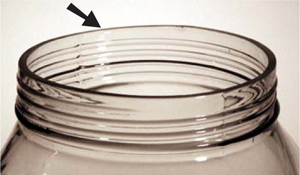
Fig. 4 Rims on new glass bodies are uneven. New rims dip up and down around the circumference of the rim (4-A). Old top rims are virtually perfectly flat throughout the circumference (4-B).

Fig. 4-A Top rims of new glass bodies dip up and down along the circumference.
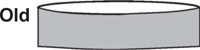
Fig. 4-B Top rims of original glass bodies are perfectly flat along the circumference.

Fig. 5 Catalog page from the reproduction wholesaler which offers the new glass bodies. A new glass base with an old beater mechanism is shown in upper right.
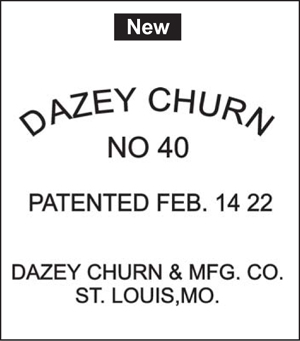
Fig. 6 Raised glass lettering molded on new glass bases, above, is almost identical to the lettering molded on original jars. New jars include the original patent date, the company name and the company's home town and state.

Fig. 7 The important difference between marks on new and old glass bases is the phrase, "Made in USA." It appears on the original glass base only; not on the new glass base from India.

Fig. 8 Bottom of the new glass base is smooth, with no circular mold mark. This new base has the original Made in India paper label.

Fig. 9 There is a circular mark molded in the bottoms of original Dazey glass bases.
 — the award-winning marketplace trusted by collectors worldwide.
Now that you know what to avoid...
♥️ Find the Real Deal on Ruby Lane
Shop with confidence from our vetted dealers who specialize in authentic vintage and antique treasures.


